Frequentist: Long term relative Frequency
- are a set of unkonw constraings
- Observed data
- Follows a sampling distribution
Bayesian: A degree of subjective belief
- are random variables
- Combine with prior belifs
- Follows Posterior Distribution
Frequentist Estimation
Estimators: MLE, Method of Moments Solving for gives the MLE estimator:
- is the number of occurrences
- total data
Bayesian Estimation
Model parameters are expressed as through prior distribution.
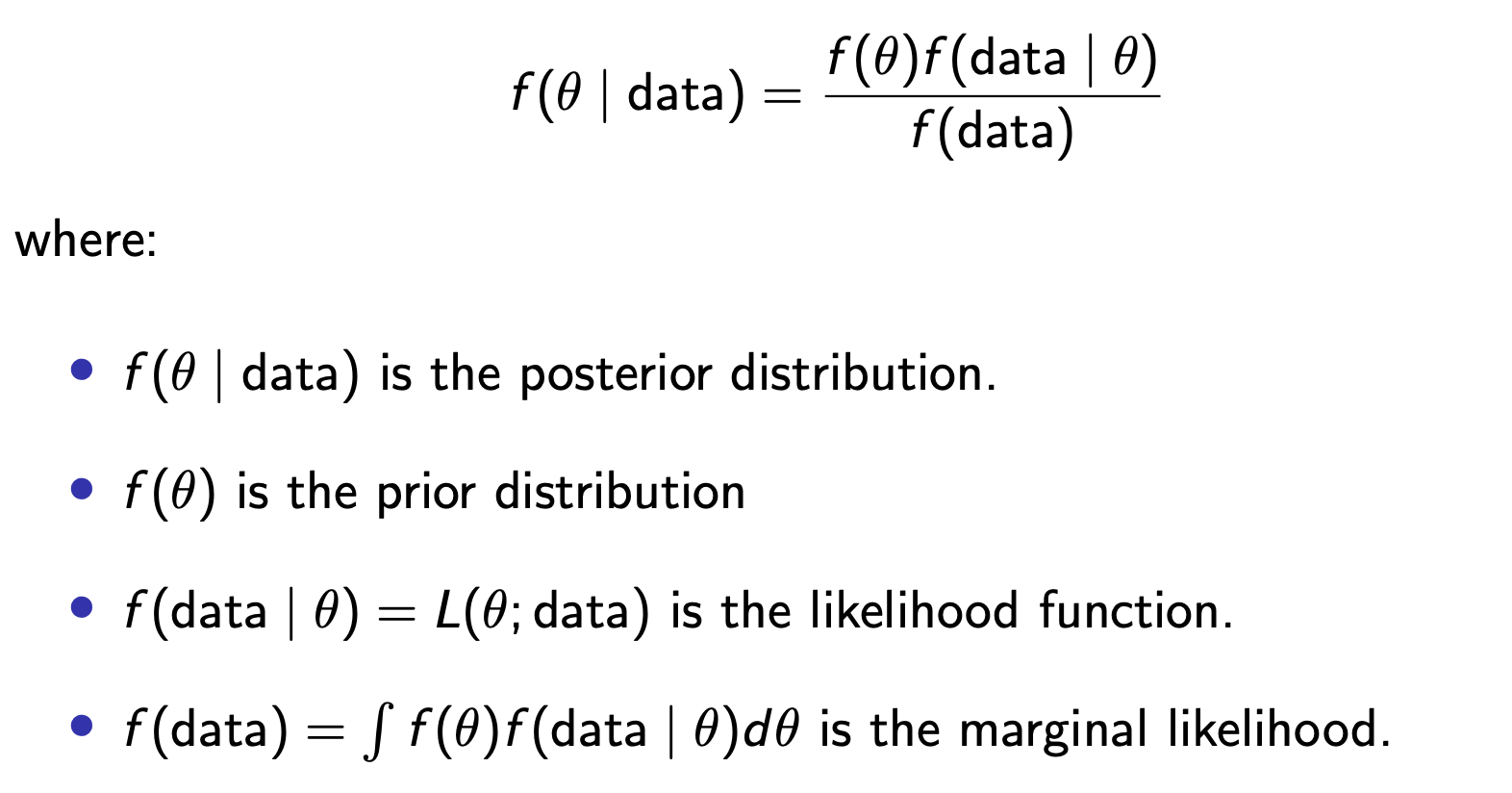
Point Estimation
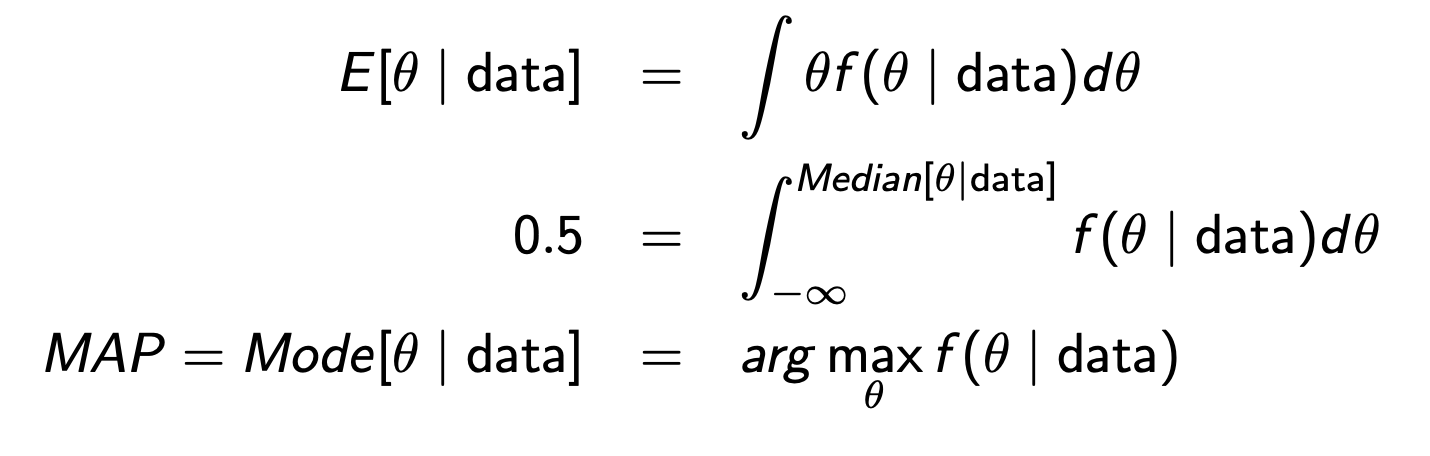
Questions:
- Assume a beta prior distribution, B(5,5), for the probability of head. Suppose we toss the coin 12 times and observe 9 heads and 3 tails. Obtain the posterior mean, median and mode. Compare with the MLE estimation.
alpha = 5
beta = 5

n = 12
heads = 9
tails = 3
alpha_post = integer(alpha) + 9
beta_post = integer(beta) + tails


post_mean   <- alpha_post / (alpha_post + beta_post)
post_median <- qbeta(0.5, alpha_post, beta_post)
post_map    <- (alpha_post - 1) / (alpha_post + beta_post - 2)
cat("mean", post_mean, "median", post_median, "mode", post_map)
mean 0.75, median 0.7642145 mode 0.8 2. Read the file sms.csv. Asuming a B(5,5) prior and given 5000 data, obtain the posterior mean, median and mode. Compare with the MLE estimation.
alpha = 5
beta = 5
data = sms
alpha_post = alpha + sum(data$type == 'spam')
beta_post = beta + (nrow(data) - sum(data$type == 'spam'))
post_mean   <- alpha_post / (alpha_post + beta_post)
post_median <- qbeta(0.5, alpha_post, beta_post)
post_map    <- (alpha_post - 1) / (alpha_post + beta_post - 2)
mle = sum(data$type == 'spam') / nrow(data)
cat("MLE Estimation",mle ,"\nmean", post_mean, "median", post_median, "mode", post_map)
MLE Estimation 0.1343767 mean 0.1350332 median 0.1349895 mode 0.1349021
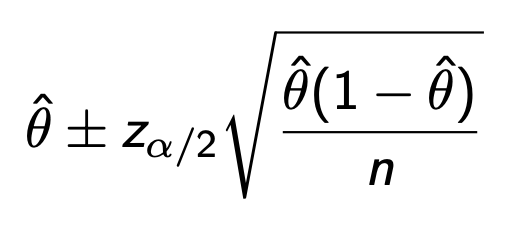
Frequentist Confidence Intervals
confidence interval for and is represented as repetitions of Random Experiments

Bayesian Confidence Intervals
Based on prior: Bayesian credible intervals are based on the posterior distribution. A credible interval is any interval (a,b) such that:

Questions: Assume a beta prior distribution, B(5,5), for the probability of head. Suppose we toss the coin 12 times and observe 9 heads and 3 tails. Obtain a 95% credible interval for the probability of head. Compare with frequentist intervals of the previous example.
alpha = 5
beta = 5
n = 12
heads = 9
tails = 3

# Bayesian Approach
alpha_post = heads + alpha
beta_post = tails + beta

confidence_interval = qbeta(c(0.025, 0.975), alpha_post, beta_post)

#Frequentist Approach
test = binom.test(heads, n, conf.level = 0.95)
confidence_interval_f = test$conf.int
cat("Bayesian Approach", confidence_interval, "\nFrequentist Approach", confidence_interval_f)
Bayesian Approach 0.4303245 0.8189284 Frequentist Approach 0.4281415 0.9451394
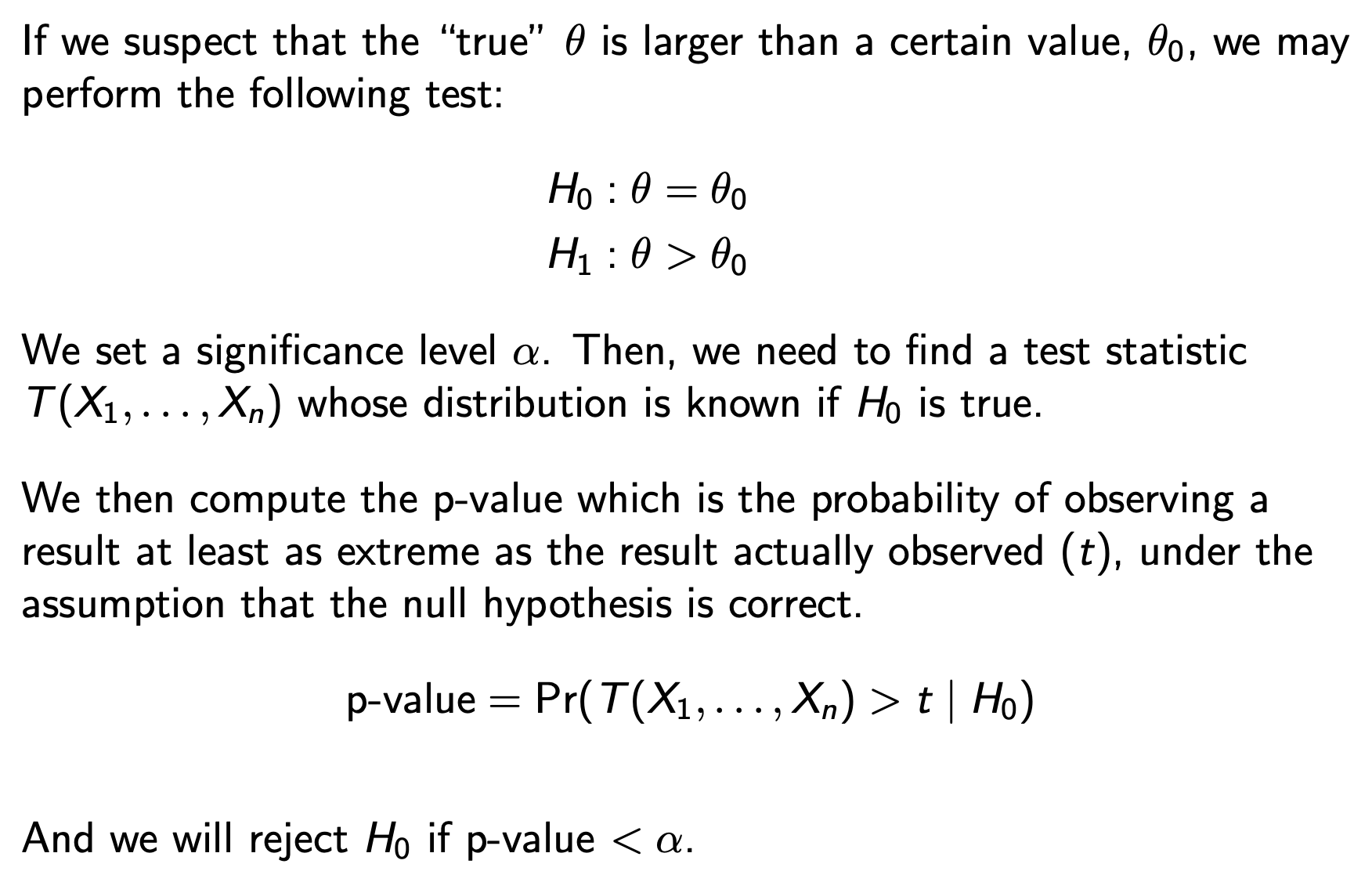
Frequentist Hypothesis Testing:
Bayesian Hypothesis Testing
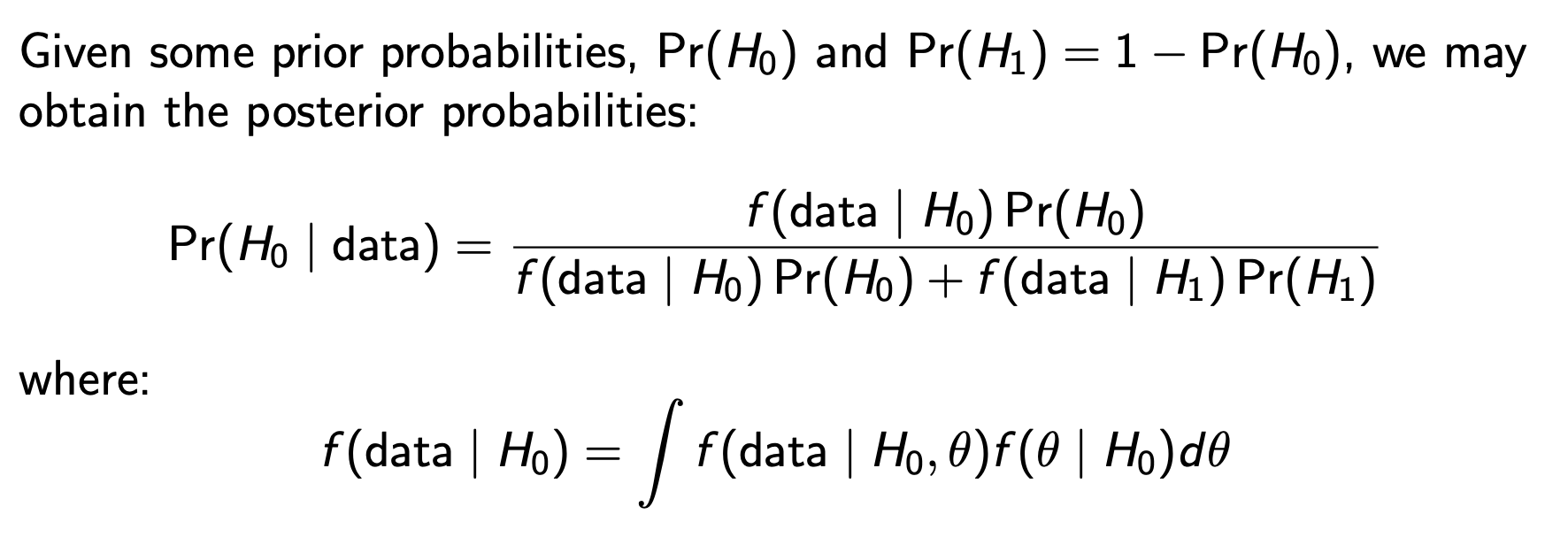
Questions: Assume a beta prior distribution, B(5,5), for the probability of head. Suppose we toss the coin 12 times and observe 9 heads and 3 tails. Test the null hypothesis, H0 : θ≤0.5 against the alternative H1 : θ>0.5. Compare with frequentist results
alpha_prior <- 5
beta_prior <- 5
freq_test <- binom.test(x, n, p = 0.1, alternative = "greater")
alpha_post <- alpha_prior + x
beta_post  <- beta_prior + (n - x)

prob_H1 <- 1 - pbeta(0.1, alpha_post, beta_post)
prob_H0 <- pbeta(0.1, alpha_post, beta_post)
--- Frequentist Results --- P-value: 1e-12 Conclusion: Reject H0
--- Bayesian Results --- P(H0 | Data): 0 P(H1 | Data): 1 Conclusion: The probability that theta > 0.1 is 100 %
The Predictive Distribution Frequentist
The predictive distribution is expressed as:
Parameter Uncertainty
This method does not fully account for parameter uncertainty. It treats the estimate as the “absolute truth,” ignoring the fact that a different sample could have yielded a different .
Bayesian Prediction: The Posterior Predictive Distribution
From the Bayesian point of view, prediction is handled by averaging over all possible values of , weighted by their posterior probability. This is known as the predictive distribution:
Question: Suppose we toss a coin 12 times and observe 9 heads and 3 tails. Predict the probability that in the next 12 tosses you observe exactly 9 heads.
p_hat <- 9 / 12
freq_pred <- dbinom(9, size = 12, prob = p_hat)
cat("Frequentist Prediction:", round(freq_pred, 4))

# Bayesian Predictions
alpha_post <- 5 + 9
beta_post  <- 5 + 3
predictive_func <- function(p) {
  dbinom(9, size = 12, prob = p) * dbeta(p, alpha_post, beta_post)
}
bayesian_pred <- integrate(predictive_func, 0, 1)$value
cat("Bayesian Prediction:", round(bayesian_pred, 4))
Frequentist Prediction: 0.2581 Bayesian Prediction: 0.1682